Xiaogao Ramen: Taipei’s Bang-for-Buck Champion — A Bowl of the Real Deal for Next to Nothing
Intro
Hey hey everyone, welcome back to our weekly ramen rundown! Today we’re heading to Xiaogao Ramen (小高拉麵) — the 27th ramen shop we’ve featured, and currently my undisputed budget champion. The bang-for-your-buck is so high that even if you ate here every single day it wouldn’t feel like a splurge. Pile on extra meat and a soft-boiled egg without a second thought — the only thing stopping you is how much you can actually finish.
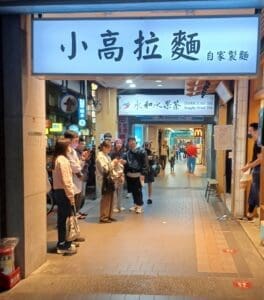
I went twice. The first time I arrived at 7:35 pm and waited 22 minutes; the second time I got there at 12:09 pm and waited 25 minutes. After two visits, plus reading through other people’s reviews online, I can basically confirm that any of you planning to come should budget some time for the line so it doesn’t throw off the rest of your day.
Now let me drop some of the basic info on Xiaogao Ramen!
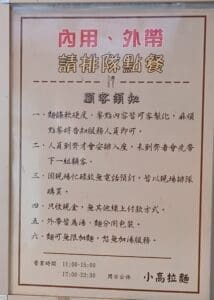
Xiaogao Ramen location and details
Xiaogao Ramen on Google Maps: https://maps.app.goo.gl/1v2tLaYcs6Tz4gno7
Hours: 11:00 am – 3:00 pm; 5:00 pm – 11:30 pm (open every day)
Seating: about 25 seats (four-person tables and a single-seat counter)
Address: No. 413-1, Dehe Rd., Yonghe Dist., New Taipei City 234
The soul of the bowl: chili oil & garlic
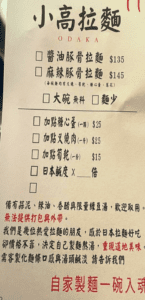
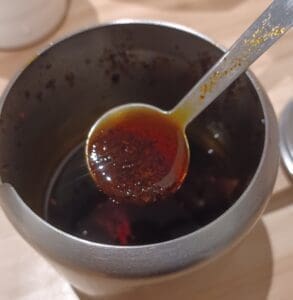
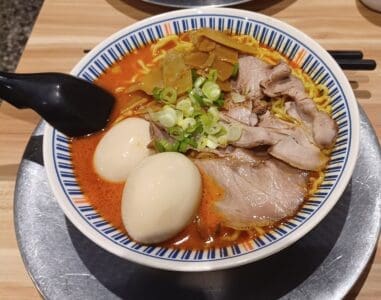
Xiaogao Ramen has two kinds of ramen: a spicy mala tonkotsu and a shoyu (soy sauce) tonkotsu. Honestly, I couldn’t really taste the difference — the “mala” one doesn’t really come across as that numbing-spicy when you eat it, though there is a tiny bit of heat. On the table you’ll find two condiments: minced garlic and chili oil.
Honestly, I strongly suspect the mala flavor is just the shoyu version with their house-made chili oil added on top. Unless you order it Japanese-style salty, the only real difference seems to be that hint of heat — nothing else stands out. And if you do go salty, even cranking up the multiplier just bumps the saltiness of the broth a notch. I think it tastes better when you add the chili oil and garlic yourself.
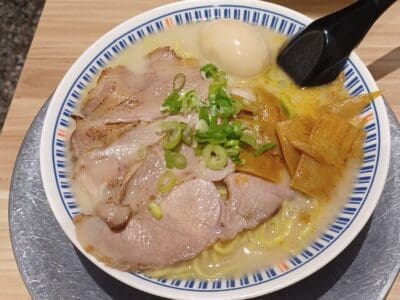
To start, give the broth a try on its own. One sip and a full-on tonkotsu richness rushes up the back of your throat and lingers for ages — this is exactly my idea of a classic tonkotsu ramen. By my standards this broth is genuinely solid. There might still be some hard-to-pin-down gap, maybe a lack of depth and layering in the broth, but I love the simple, honest character this bowl has.
On my second visit I tried it Japanese-style salty at double strength, but it had the same issue. It’s clearly a step below those NT$300-something bowls — but as for exactly what the difference is, honestly I have no idea how to put my finger on it.
But as the saying goes: tonkotsu + garlic = delicious. No matter which tonkotsu ramen you get, the moment you add some garlic the whole bowl is transformed. I don’t know what kind of magic spell it casts, but one spoonful of garlic and the entire bowl turns super tasty.
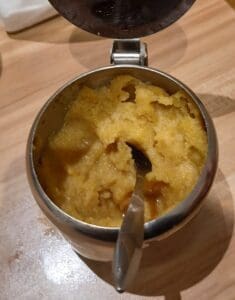
So I highly recommend that, after tasting the broth on its own, you add some garlic and chili oil yourself — it’ll give you a flavor you didn’t see coming. If you’re not scared of garlic, personally I say just dump in a ton of it. But if you’re here on a date, maybe hold off this time, or there’ll be no kissing afterward.
Xiaogao Ramen — the noodles
As for the noodles themselves, I’d say they’re your standard ramen noodles — thickness somewhere in the middle, neither thick nor thin, with a slight chewy bounce to them. You can get free noodle refills, and apparently someone has gone as far as eight refills, but I reckon by your second refill there’s plenty of broth left for them and any more starts to feel a bit monotonous.
Xiaogao Ramen — the perfectly done soft-boiled egg
I also absolutely love the soft-boiled egg! It’s cooked to just the right doneness — the yolk runs when you bite in, and it’s neither too sweet nor flavorless, just enough to mask any eggy smell. The chashu pork is fairly by-the-book: they cut it into chunks and then give it a quick sear with a blowtorch. It’s not exactly creative, but at least it’s not bad, right? And unlike some Japanese ramen shops that skimp on the chashu count to save on costs, here they’re really generous with it — that’s definitely worth a thumbs-up.
Wrapping up
Alright, let’s wrap this up! This bowl of ramen is a serious bargain — you really don’t need to fret over whether adding chashu or an egg will cost too much. When you come here, the move is to just add everything! As for the broth, this bowl doesn’t feel slapped together at all; if anything, it’s already close to the taste of proper Japanese ramen. It might not blow you away, but it nails every single thing to an 80-out-of-100 level, and none of the toppings are skimped on in the slightest. If you suddenly get a craving for ramen but you’re broke at the end of the month, you absolutely have to come give this a try!
Okay, thanks for reading, everyone! I’m Mydondon — if you enjoyed this post, feel free to hit like and bookmark it, and if you want to see more, go ahead and follow me! Below is my long-running ramen article series along with some other posts I recommend for you — go check them out!