The Legendary Man’s Ramen: What Makes Jiro-Style Ramen So Irresistible?
Iekei ramen, Tokushima ramen, Jiro-style ramen — the world is full of all kinds of ramen. Over roughly 150 years of evolution, fighting it out in a fiercely competitive scene, ramen has slowly branched into a huge variety of flavors. You can even walk into different branches of the same shop and taste something completely different. If you really tried to break it all down, you’d never finish — but in broad strokes, you can still sort ramen into a handful of distinct schools. From Rairaiken’s “Tokyo shoyu ramen,” the very first to appear, to the rarely-talked-about “Tokushima ramen,” I want to share all the different ramen styles I could dig up online. Today is episode two of this series: Jiro-style ramen.
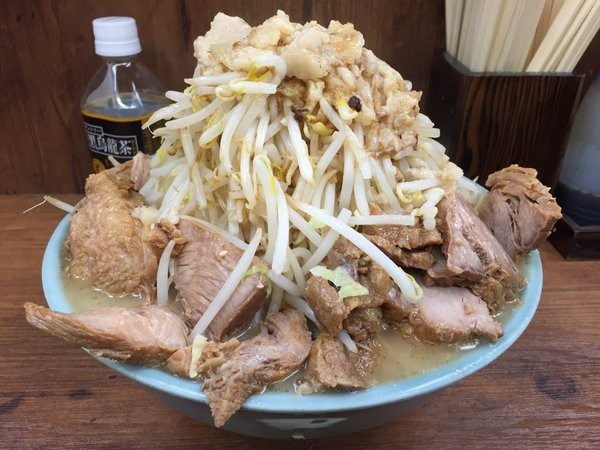
You could call Jiro-style ramen the ultimate man’s ramen. Why do I say that? Because every single bowl is so overflowing that one person can’t even finish it — they won’t rest until each bowl is piled up like a mountain. Here are the defining features of Jiro-style ramen.
- Huge portions — a single bowl usually packs 150–600 grams of noodles (regular ramen is around 60–100 grams)
- Toppings are mostly bean sprouts, garlic, chashu pork, and back fat
- Extra toppings are free
- The broth is usually a rich tonkotsu shoyu base
- Jiro-style ramen isn’t a type of ramen — it’s a sacred food called “Jiro”
The first time I encountered Jiro-style ramen, I too was stunned by that towering mountain of bean sprouts. For me, Jiro-style ramen has always been my absolute favorite. The earliest Jiro-style ramen traces back to the famous shop “Ramen Jiro” near Keio University’s Mita campus. Back then, the shop’s whole selling point was letting you eat your fill of bean sprouts, mountains of cabbage, back fat, and raw garlic. Just like how iekei ramen rose to fame, everyone who tried it thought it was incredible, so it gradually caught on — even spawning a legion of die-hard Jiro fans.
Among these fanatical fans, Jiro-style ramen isn’t a kind of ramen at all but a sacred food known as “Jiro.” On top of that, because you can adjust the amounts of raw garlic, noodles, bean sprouts, and back fat yourself, they’ve developed a whole vocabulary around it. To add one extra portion of “raw garlic, pork back fat, or veggies,” you say “マシ” (mashi); to double it, you say “マシマシ” (mashimashi). For example, double the vegetables is “やさいまし” (yasai mashi), and doubling absolutely everything is “全部ましまし” (zenbu mashimashi).
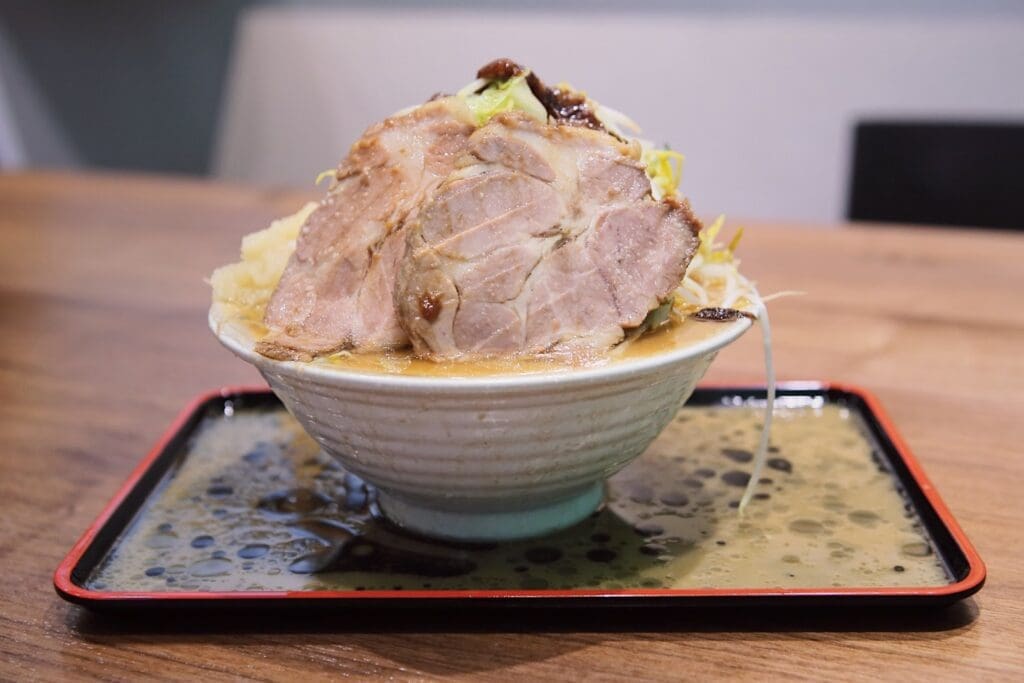
There’s also a fun challenge baked into the Jiro-style ramen world. Within this ecosystem there’s a unique title called “ジロリアン” (Jirorian) — basically a fanatical Jiro devotee! To call yourself a true Jirorian, you have to eat at least 3 bowls of Jiro-style ramen every week. Only then do you earn the right to claim the title.
If you want to eat Jiro-style ramen in Taiwan, the most recommended spot is the “Ichi no Jiro Ramen” at “Menya Ichi no Ana” in New Taipei City — crowned the best-value Jiro-style ramen in the Taipei area. My personal favorite, though, is the “Niku Daku Daku SP” at “Takaryu Tokyo Tonkotsu Ramen – Gokujo.” And for Jiro-style ramen in Taichung, I’d recommend the “Kuang Tun Shan” at “Tun Shan Lang.”
Alright, thanks everyone for reading! Because of time constraints there wasn’t a ton of content this time, so let me apologize for that. Down the road I’ll pull together all the articles introducing the different ramen schools into one place. If you Macs (that’s you, my readers!) want to see more, feel free to hit follow — and I’ll see you next time!
References and image sources for this article: